
ANCIENT EGYPT: BUILDING A CIVILISATION ALONG THE NILE
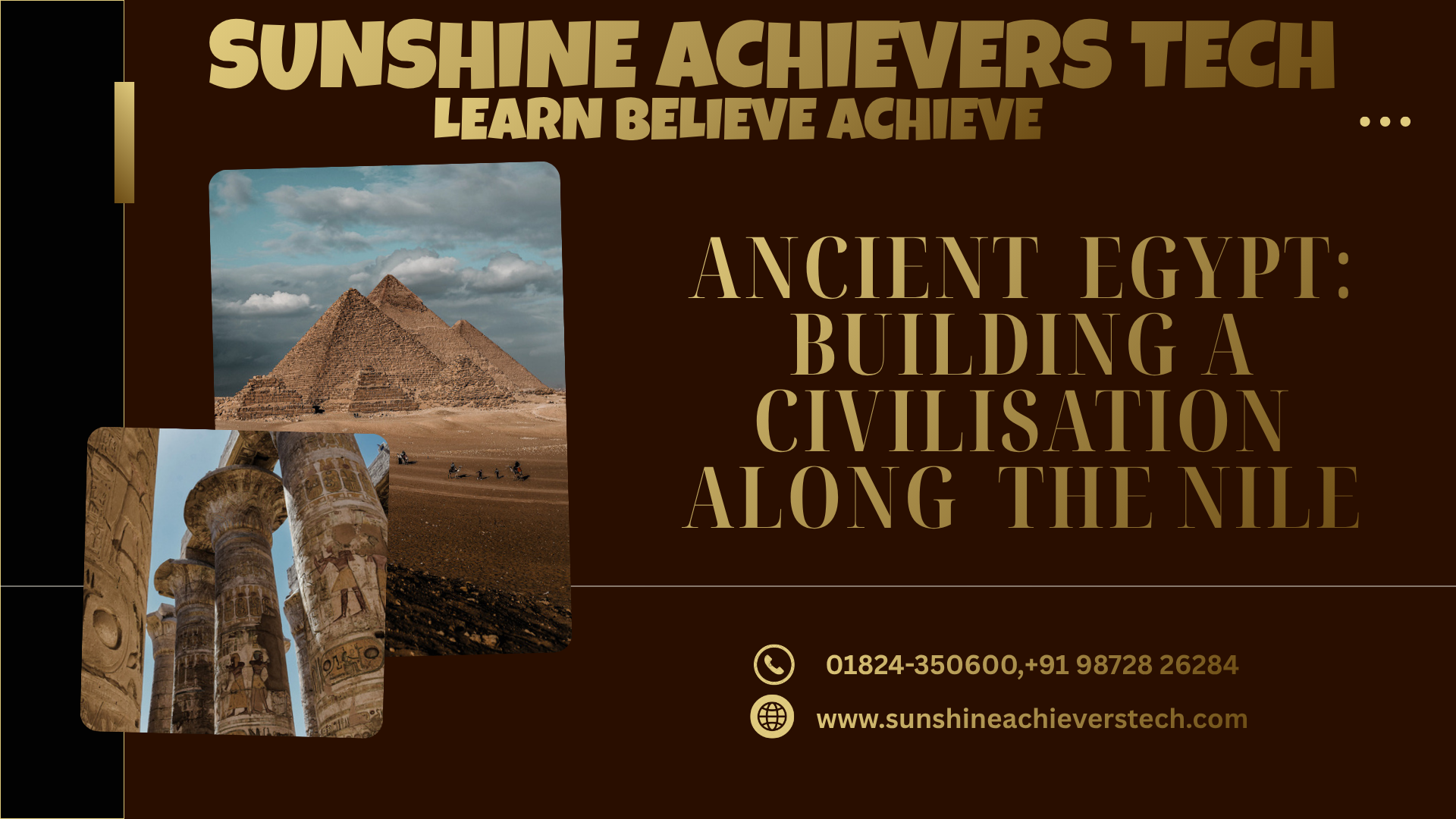
Ancient Egypt developed along the banks of the Nile River, where annual flooding deposited fertile silt onto surrounding farmland. This predictable cycle enabled communities to produce reliable harvests, supporting population growth and the development of one of the world's earliest complex civilisations. Historians generally agree that agriculture played a central role in Egypt's economic and political stability, although the influence of other environmental and social factors continues to be studied.
The Egyptians became well known for their achievements in architecture, engineering and administration. Large monuments, including pyramids and temples, required careful planning, skilled labour and effective organisation. Contrary to a long-standing popular belief, archaeological evidence suggests that the pyramids were constructed mainly by paid workers and seasonal labourers rather than by enslaved people. Excavations have uncovered workers' villages containing living quarters, tools, food remains and cemeteries, providing valuable insight into daily life during large construction projects.
The construction of pyramids continues to attract scientific interest. Researchers have proposed several explanations for how massive stone blocks were transported and raised into position. Some studies suggest that specially prepared ramps may have been used, while others argue that combinations of ramps, sledges and human labour were employed. Although numerous theories have been developed, no single explanation has gained universal acceptance, and archaeologists continue to examine new evidence.
Ancient Egyptian society also demonstrated remarkable advances in medicine. Medical papyri describe treatments for wounds, fractures and certain illnesses, while archaeological discoveries indicate that some surgical procedures were successfully performed. Nevertheless, Egyptian medicine combined practical observation with religious beliefs, and many illnesses were believed to have both physical and spiritual causes.
The preservation of mummies has provided researchers with valuable information about ancient health, diet and disease. Modern technologies such as CT scanning and DNA analysis allow scientists to investigate mummified remains without causing significant damage. These methods have revealed evidence of injuries, infections and hereditary conditions, but researchers acknowledge that some conclusions remain uncertain because preservation varies considerably between individual mummies.
Despite more than two centuries of archaeological research, many aspects of Ancient Egyptian civilisation remain incompletely understood. New discoveries continue to reshape interpretations of Egyptian society, technology and daily life.
Questions 1–12
Do the following statements agree with the information given in the passage?
Write
TRUE
FALSE
NOT GIVEN
1. Ancient Egypt developed primarily because of fertile land created by the Nile's annual floods.
2. The Nile River is longer than every other river in Africa.
3. Archaeological discoveries suggest that most pyramid builders were not slaves.
4. Every pyramid in Ancient Egypt was built using exactly the same construction method.
5. Researchers agree that ramps were definitely the only method used to build the pyramids.
6. Ancient Egyptian medical knowledge included both practical treatments and religious beliefs.
7. The oldest pyramid was completed during the reign of Ramses II.
8. Modern CT scanning enables scientists to study many mummies without seriously damaging them.
9. DNA analysis has answered every question about diseases in Ancient Egypt.
10. Workers who built the pyramids received identical wages throughout Egyptian history.
11. Researchers continue to discover new information about Ancient Egyptian civilisation.
12. Some archaeological conclusions remain uncertain because mummies differ in their state of preservation.
Summary
This IELTS reading passage explores the rise of Ancient Egypt along the fertile banks of the Nile River and explains how agriculture supported one of the world's earliest civilizations. It discusses the construction of pyramids, archaeological evidence about the workers who built them, advances in architecture, engineering, medicine, and mummification, as well as the use of modern technologies such as CT scanning and DNA analysis to study ancient remains. The passage also highlights that many aspects of Ancient Egyptian civilization are still being investigated, making it an excellent resource for IELTS Reading True, False, and Not Given practice.