
STONEHENGE: DECODING AN ANCIENT MONUMENT
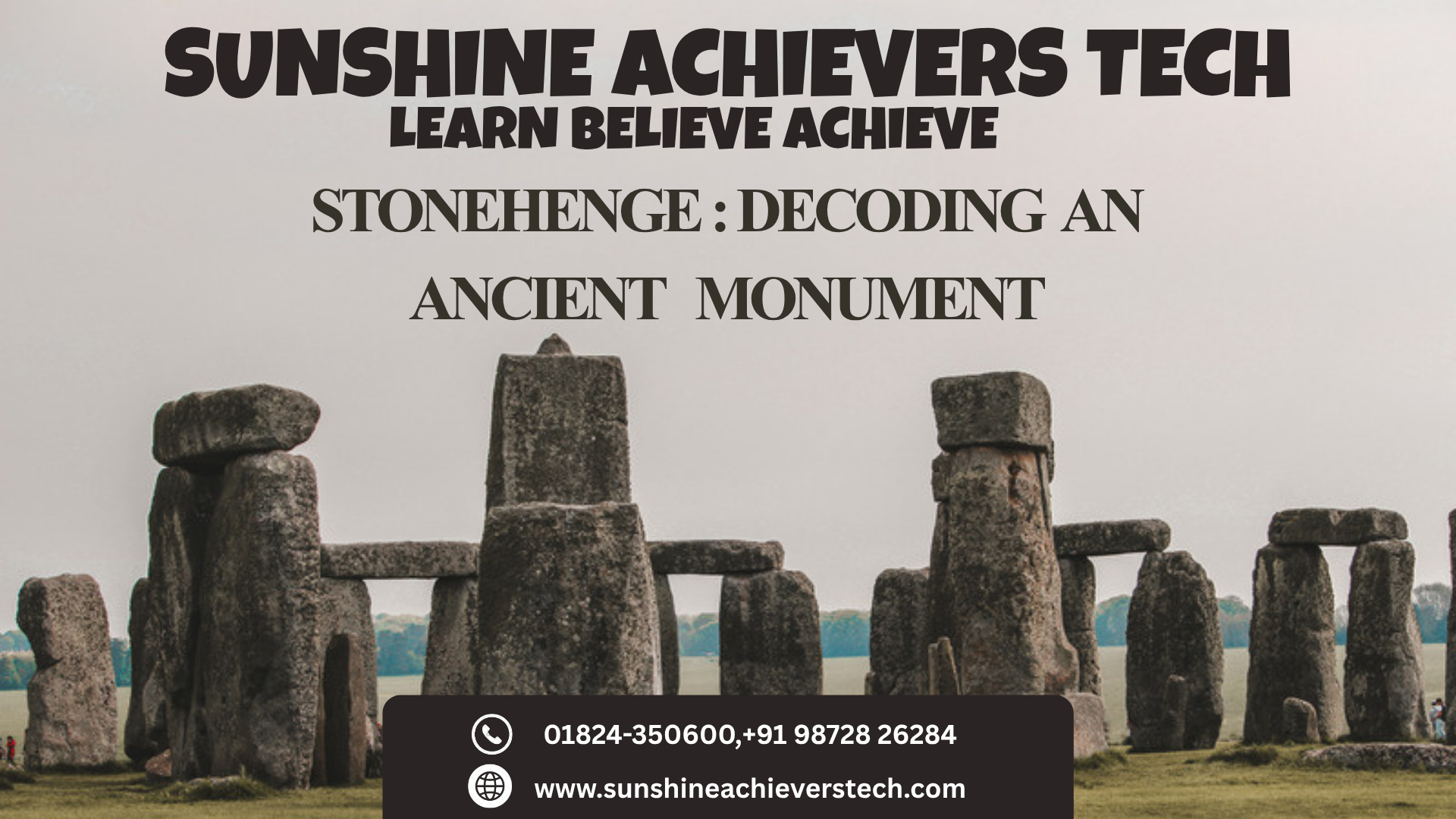
Stonehenge, located on Salisbury Plain in southern England, is one of the world's most famous prehistoric monuments. Built in several stages over many centuries, it consists of massive standing stones arranged in circular and horseshoe-shaped patterns. Although archaeologists have learned a great deal about its construction and development, many aspects of its original purpose remain uncertain.
Scientific evidence indicates that the monument was constructed during different periods rather than as a single project. Researchers believe that the earliest earthworks were created before the largest stones were erected. The enormous sandstone blocks, known as sarsens, were transported from relatively nearby locations, while the smaller bluestones originated from western Wales, hundreds of kilometres away. Exactly how these stones were moved continues to be debated, although several practical explanations involving sledges, rollers and waterways have been proposed.
For many years, Stonehenge was believed to have functioned primarily as a religious temple. More recent research, however, suggests that the monument may have served several purposes over time, including ceremonial gatherings, astronomical observations and burial activities. Archaeologists emphasise that these explanations are not necessarily mutually exclusive, and no single theory has gained universal acceptance.
Excavations around Stonehenge have uncovered cremated human remains, animal bones, tools and evidence of nearby settlements. These discoveries have helped researchers reconstruct patterns of prehistoric life and understand how the monument fitted into a wider landscape used by ancient communities. Nevertheless, many archaeological features remain buried, and new excavations continue to produce unexpected findings.
Modern technologies have transformed the study of Stonehenge. Ground-penetrating radar, aerial surveys and radiocarbon dating have revealed previously unknown structures beneath the surrounding landscape without extensive excavation. These methods have expanded archaeological knowledge while reducing disturbance to fragile sites. However, scientists recognise that technological advances cannot answer every question about prehistoric societies, and interpretations continue to change as fresh evidence becomes available.
Today, Stonehenge remains one of archaeology's greatest puzzles. Rather than providing definitive answers, each new discovery often raises additional questions about the beliefs, engineering skills and social organisation of the people who built it.
Questions 1–12
Do the following statements agree with the information given in the passage?
Write:
TRUE
FALSE
NOT GIVEN
1. Stonehenge was constructed over an extended period rather than all at once.
2. The bluestones used at Stonehenge are heavier than the sarsen stones.
3. Archaeologists have reached complete agreement on how the stones were transported.
4. Researchers believe Stonehenge may have had more than one purpose.
5. The builders of Stonehenge used wooden wheels to transport every stone.
6. Stonehenge functioned only as a religious temple throughout its history.
7. Most of the people buried near Stonehenge were children.
8. Modern technology has revealed archaeological features without requiring extensive excavation.
9. Scientists have now solved every major mystery surrounding Stonehenge.
10. Stonehenge attracted visitors from continental Europe during prehistoric times.
11. Radiocarbon dating has contributed to archaeological research at Stonehenge.
12. Technological advances have eliminated the need for future archaeological investigations.
Summary
This IELTS reading passage explores the mystery of Stonehenge, one of the world's most famous prehistoric monuments. It explains how the monument was constructed over several centuries using massive sarsen stones and bluestones transported from distant locations. The passage discusses competing theories about Stonehenge's purpose, including religious ceremonies, astronomical observations, and burial practices, while highlighting archaeological discoveries and the role of modern technologies such as ground-penetrating radar, aerial surveys, and radiocarbon dating. It also emphasizes that many questions about Stonehenge remain unanswered, making it an excellent IELTS Reading True, False, and Not Given practice passage.